Chronica der Provintz Lyfflandt

Balthasar Russow · 1584 · Low German

Chronica der Provintz Lyfflandt

Balthasar Russow’s Chronicle of Livonia

1584 · Balthasar Russow · Low German · 428 pages

The most important chronicle of the Livonian War and the destruction of the medieval Livonian Confederation. Russow, a Lutheran pastor in Reval (Tallinn), wrote as an eyewitness to the catastrophic events of 1558–1583: the Russian invasion under Ivan the Terrible, the dissolution of the Livonian Order, the Swedish and Polish-Lithuanian conquests, and the suffering of the Baltic peoples. First published in 1578, this expanded 1584 edition adds new chapters on the war’s aftermath. Written in Low German, it is the definitive contemporary source for the fall of medieval Livonia.
Folio p0011 of 428
Folio p001

Original (Low German)

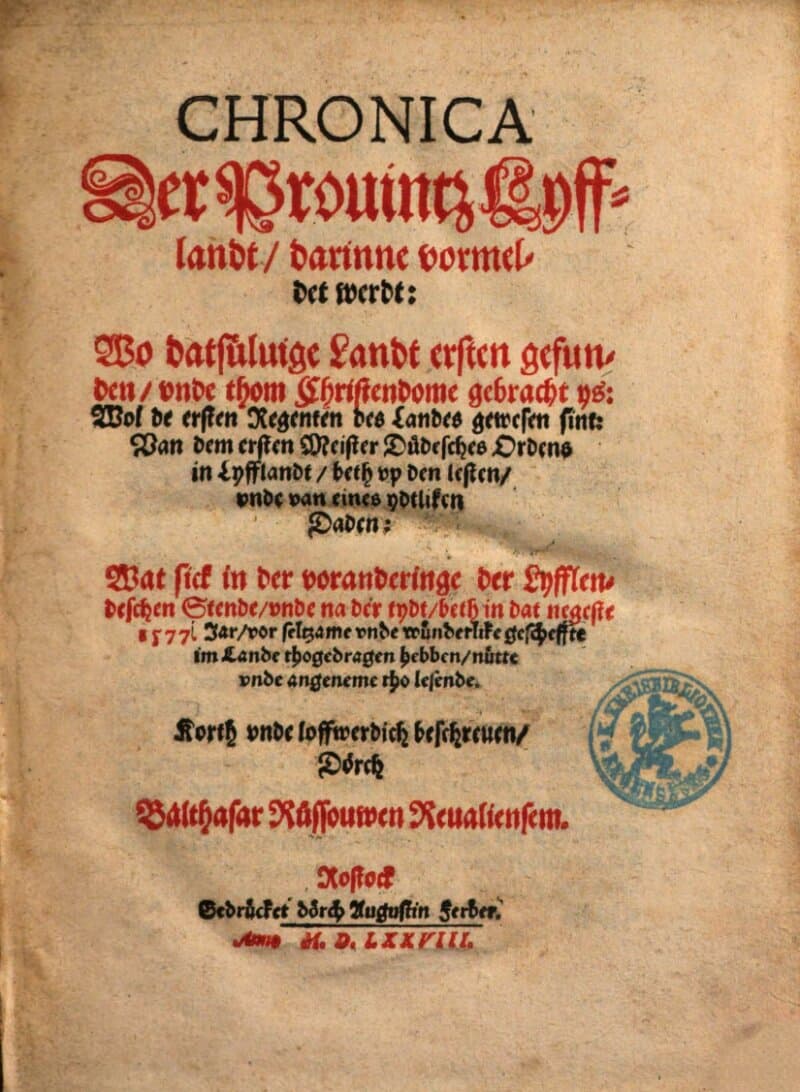
CHRONICA Der Provintz Lyfflandt, darinne vormeldet werdt: Wo datsülvige Landt ersten gefunden, vnde thom Christendome gebracht ys... Dorch Balthasar Rüssouwen Revaliensem. Rostock Gedrucket dörch Identity Augustin Ferber. Anno M.D.LXXVIII.

English Translation
Title page of the Chronica der Provintz Lyfflandt (Chronicle of the Province of Livonia) by Balthasar Russow of Reval (Tallinn). Printed in red and black Fraktur. 'In which is told: How this land was first discovered and brought to Christianity; who the first rulers of the land were; from the first Master of the German Order in Livonia to the last, and each one's deeds. Also what changes befell the Livonian estates, and what strange and wondrous things happened in this land in the past 1577 years, useful and pleasant to read. Briefly and commendably described by Balthasar Russow of Reval. Rostock, printed by Augustin Ferber, Anno 1578.' BSB library stamp visible in lower right.
Folio p0022 of 428
Folio p002

Original (Low German)

[Verso of title page]

English Translation
Verso of title page. Blank or with printer's device.
Folio p0033 of 428
Folio p003

Original (Low German)

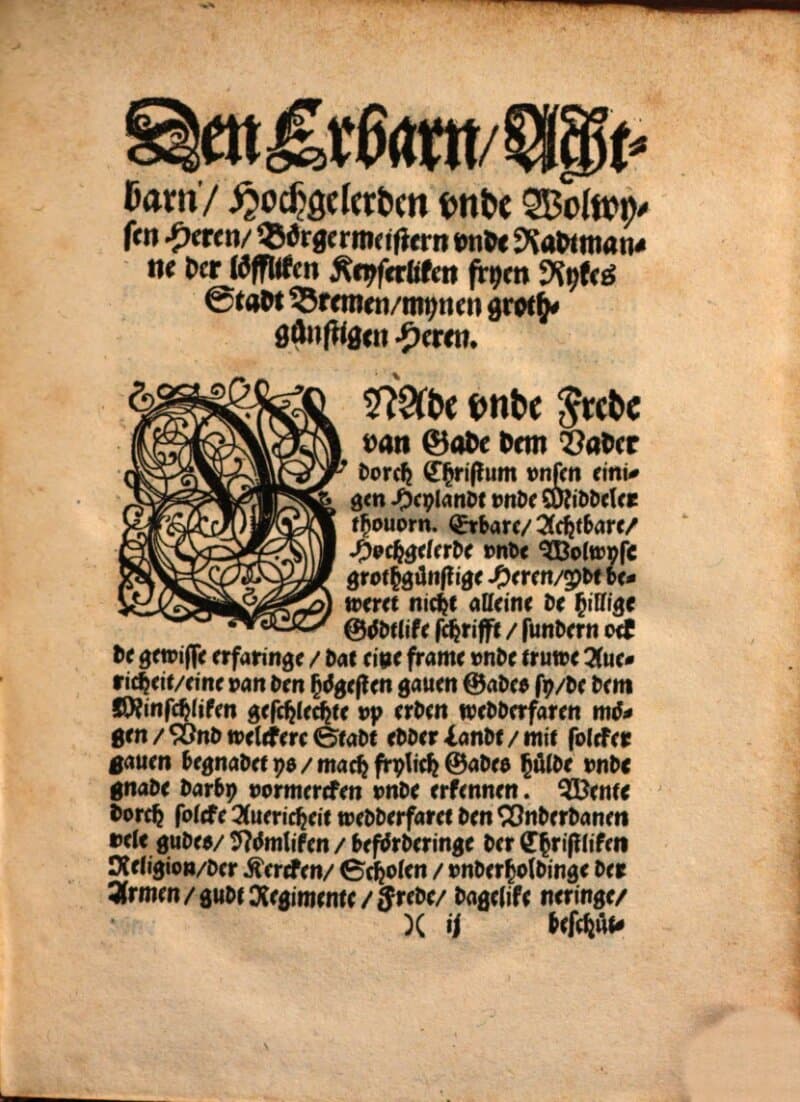
[Dedication or prefatory matter]

English Translation
Prefatory matter following the title page. Russow's chronicle is dedicated to the city council and citizens of Reval (Tallinn), where he served as a Lutheran pastor at the Church of the Holy Spirit.
Folio p0044 of 428
Folio p004

Original (Low German)

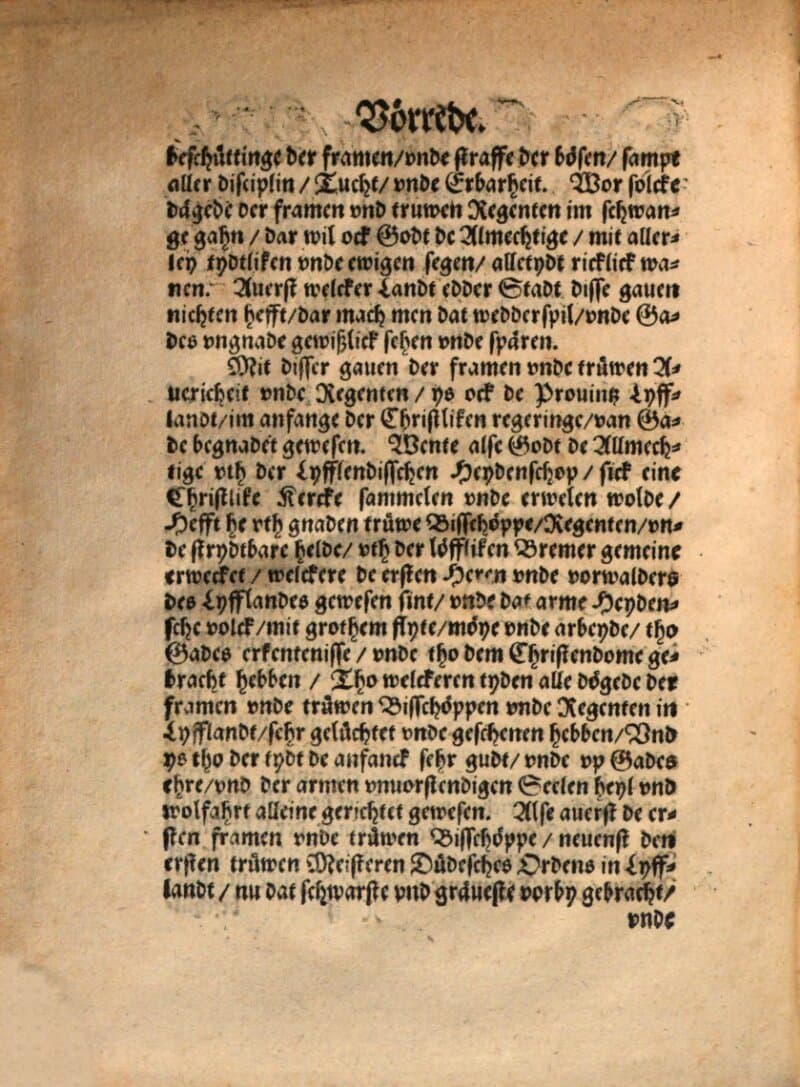
Vorrede. An den Erbaren... Rath der Stadt Reval...

English Translation
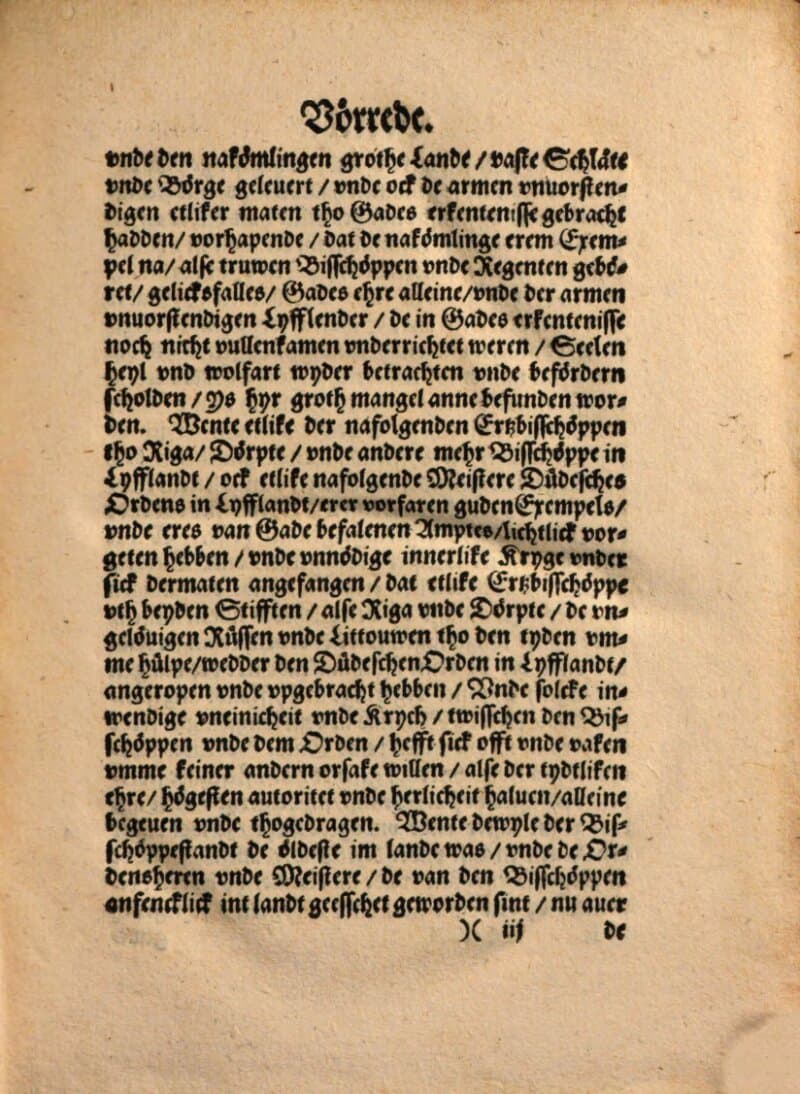
Beginning of the Vorrede (Preface). Russow addresses the 'Honorable Council of the City of Reval,' explaining his motivations for writing the chronicle. He states that Livonia has suffered such catastrophic destruction in recent years (the Livonian War, 1558-1583) that its history risks being lost. As a native-born Livonian, he feels compelled to record what he has witnessed and learned from reliable sources, so that future generations may understand what happened to their land.
Folio p0055 of 428
Folio p005

Original (Low German)

Vorrede (continued)... vnder den naffkoemelingen grosse Lande, vele Städte vnde Dörper... de armen vnuorstendigen Luden...

English Translation
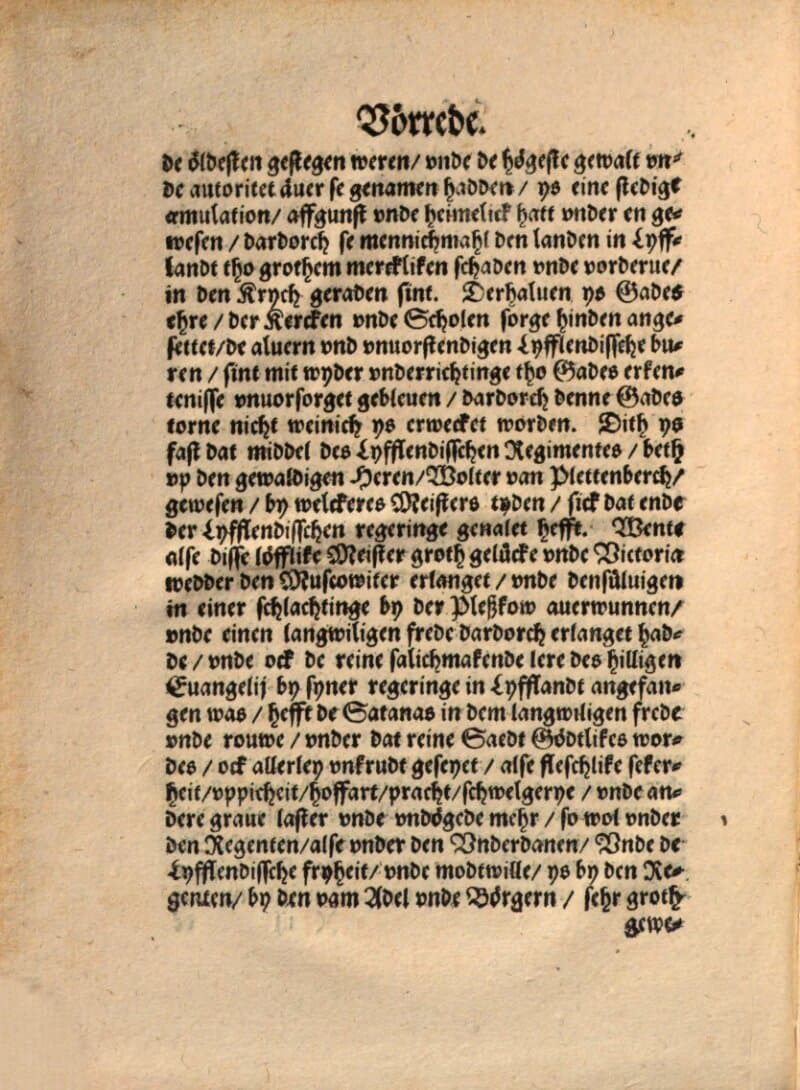
Preface continued. Russow describes the wealth that Livonia once possessed: great lands, many cities and villages, a prosperous nobility, and thriving trade. He laments how war has reduced this to ruins. He defends his decision to write in Low German rather than Latin, explaining that he wants ordinary people -- not just scholars -- to understand their own history. This was a deliberate populist choice that made the chronicle widely accessible across the Baltic and northern Germany.
Folio p0066 of 428
Folio p006

Original (Low German)

Vorrede (continued)... den Adel vnde de Geistlickeit... im Lande geuallen...

English Translation
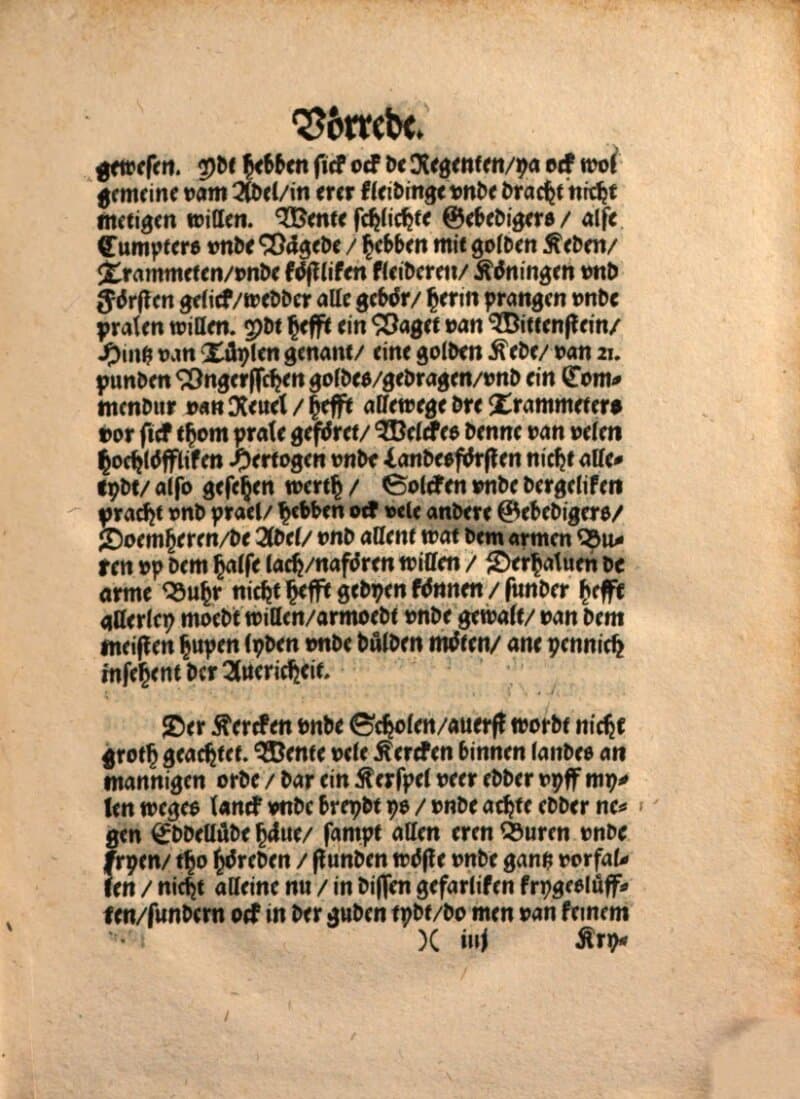
Russow discusses the fall of the Livonian nobility and clergy. He describes how the German-speaking ruling class was decimated by the Russian invasion, with many killed, captured, or driven into exile. The churches were despoiled, monasteries destroyed, and the entire social order of medieval Livonia collapsed within a few years. Russow writes with the passion of an eyewitness to catastrophe.
Folio p0077 of 428
Folio p007

Original (Low German)

Vorrede (continued)... de Muscowiter... dat Landt vorheret...

English Translation
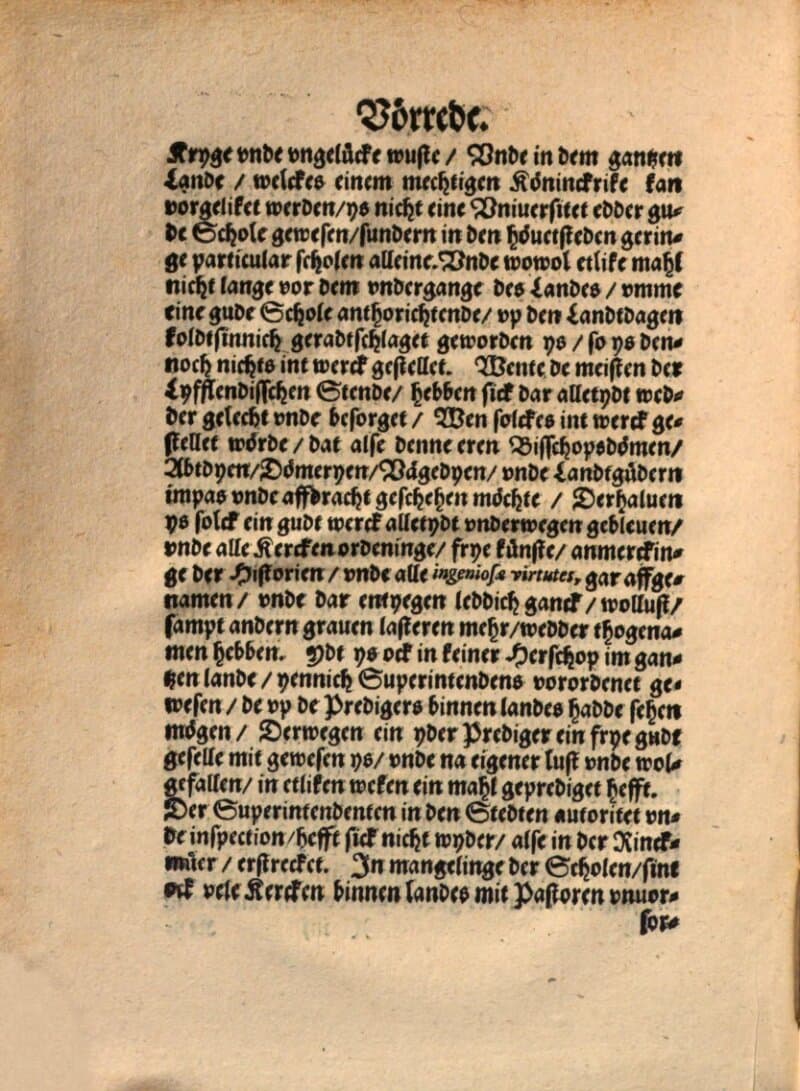
The preface describes the Muscovite (Russian) invasion specifically. Russow characterizes Ivan the Terrible's forces as a divine punishment for the sins and moral decay of the Livonian ruling class. This theological interpretation was common in Reformation-era chronicles -- military defeat was understood as God's judgment on a corrupt society. The preface previews the chronicle's main themes: war, destruction, and the wages of sin.
Folio p0088 of 428
Folio p008

Original (Low German)

Vorrede (continued)... de Bisschoppe vnde Ertzbisschoppe... reformacion...

English Translation
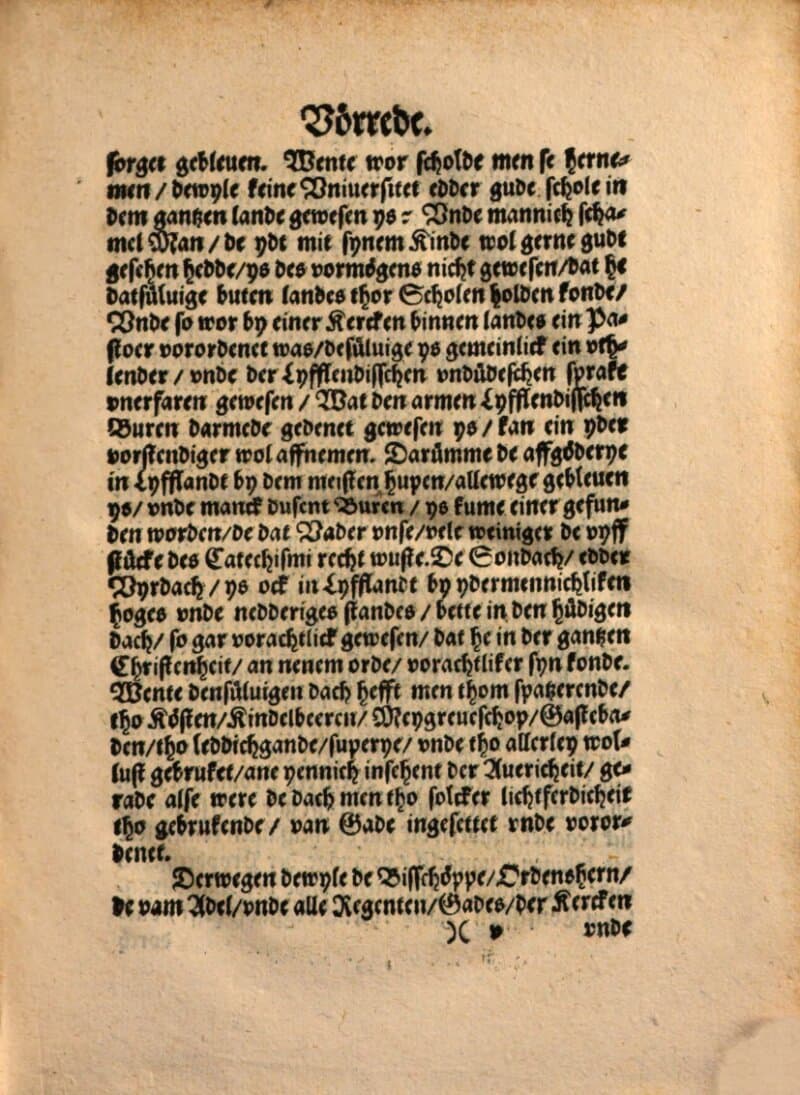
Russow discusses the bishops and archbishops of Livonia and the Reformation. As a committed Lutheran, he presents the pre-Reformation Catholic church in Livonia as corrupt and worldly. He describes how the Reformation swept through the Baltic cities in the 1520s, transforming religious life but also creating new divisions between Lutheran cities and Catholic bishops. The religious conflicts weakened Livonia's ability to resist external threats.
Folio p0099 of 428
Folio p009

Original (Low German)

Vorrede (continued)... Christen geloven... Lyfflandt... Muscowiter...

English Translation
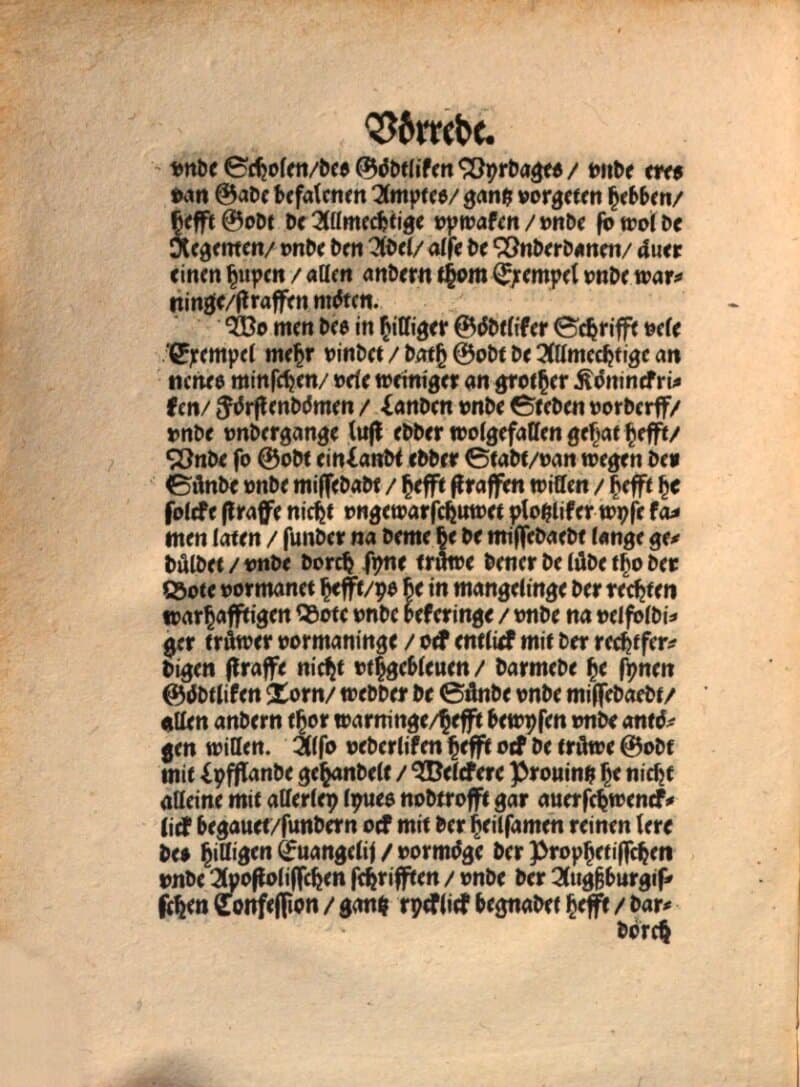
Russow continues his preface with reflections on Christian faith and the meaning of Livonia's suffering. He argues that true Christianity requires moral reform, not merely outward observance. The chronicle will show how Livonia's fall resulted from internal decay -- corruption, greed, and fratricidal conflict between the Order, the bishops, and the cities -- rather than purely from external aggression.
Folio p01010 of 428
Folio p010

Original (Low German)

Vorrede (continued)... von Steenden vnd Bisschoppen... de Muscowiter de erbarmlike jamer...

English Translation

The preface nears its conclusion. Russow describes the 'pitiable misery' inflicted by the Muscovites and the responsibility of Livonia's own leaders for failing to prepare adequate defenses. He promises that the chronicle will provide an honest and unsparing account of events, sparing no one -- neither the Order, nor the bishops, nor the city councils -- in assigning blame for the catastrophe.

Loading more pages… (10 of 428 loaded)