Livonian Rhymed Chronicle

Anonymous (Livonian Order) · c. 1290 (copied 1415) · Middle High German

Livonian Rhymed Chronicle

Livländische Reimchronik

c. 1290 (copied 1415) · Anonymous (Livonian Order) · Middle High German · 148 pages

The earliest known historical narrative of the Baltic crusades, composed in 12,017 rhyming couplets. Describes the founding of Riga, the Livonian Brothers of the Sword, and the conquest of the indigenous Baltic peoples. Codex Palatinus Germanicus 367.
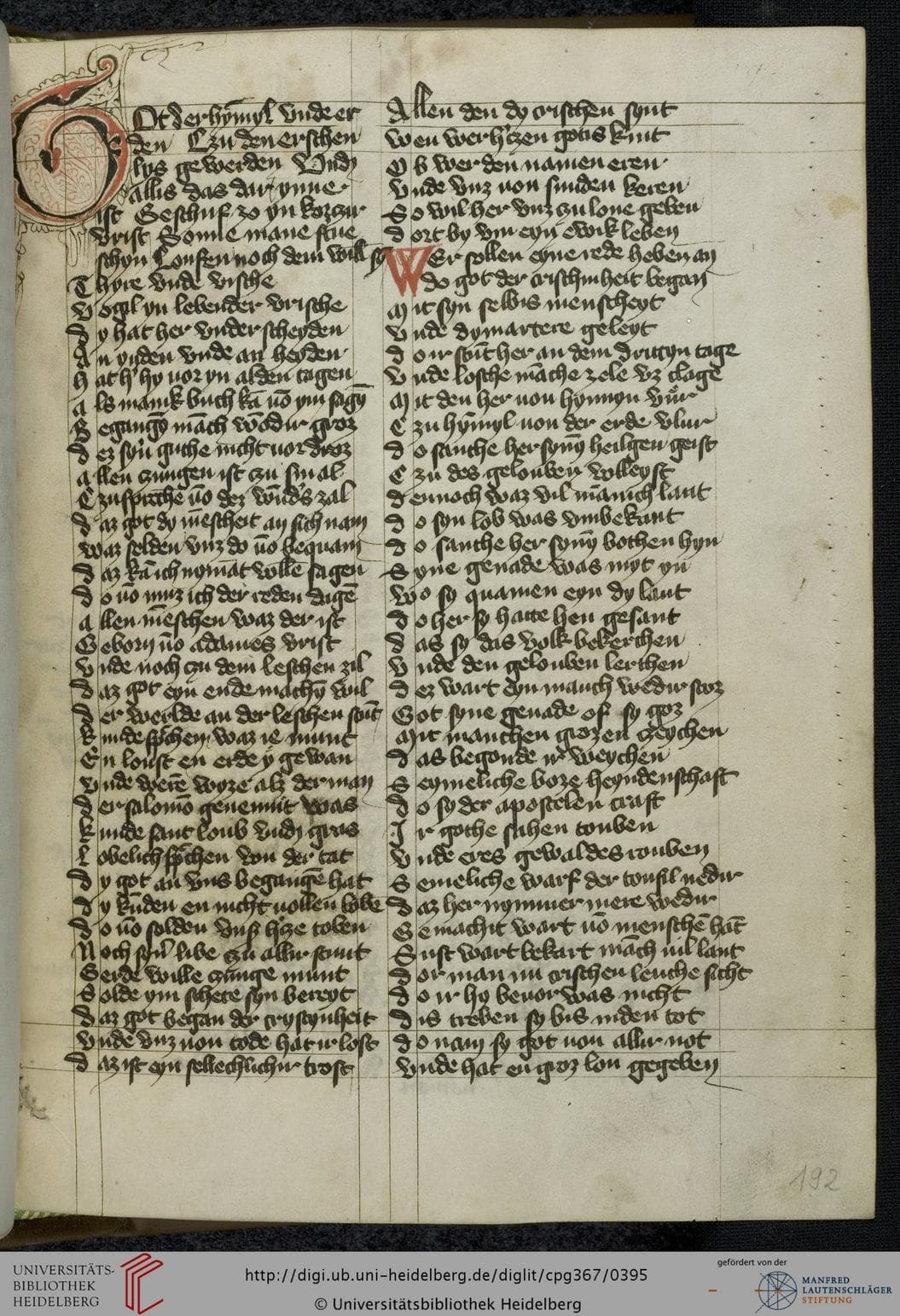
Folio 192r1 of 148
Folio 192r

Original (Middle High German)

Got der hymel unde erden / den un den erthen / aller geschepfe alse gewalt / geschuf so in der gotheit balt / drisse cleine unde gros / den louffen noch den willen blos / Thore unde blysse... / Allen den dy cristen sint / wir werhen grosz Sint / y is wir den namen eren / unde daz von sunden keren / do wolhor dut ou lone geben / der by duz eyn ewik seben / Wir sollen eine rede heben an / dy got der cristheit began / du hat dynartere gelert / do spit her an den dritten tage / unde losthe mache rede dy clage / yst du her von hymmen duz / za hymmel von der erde bluz / o sunghe her syny heiligen geist / y zu dy gelouben volleist / desnoch was dy manich kint / do suythe her syny boten hyn / syne gnade was myt yn / do sy quamen eyn du kint / do her sy hate hen gesant / als dy folk bekerchen / unde den gelouben lerthen

English Translation

God, who created heaven and earth, all creatures in His divine power, the small and the great alike, the course of stars and the free will — He shaped all things in His godly strength. To all those who are Christians, we offer great greeting. You who honor the name of Christ and turn away from sin, to you God shall give reward and grant eternal life. We shall now begin a tale of what God began for Christendom. He taught His followers well, and on the third day He rose again, releasing many from their sorrow and lamentation. He ascended from earth to heaven and sent forth His Holy Spirit to strengthen all the faithful. Yet many peoples still remained unconverted, so He sent His messengers forth, and His grace was upon them. When they came among the peoples where He had sent them, they converted the folk and taught them the true faith. Much opposition stood before them, but God poured His grace upon them and they performed great miracles. Some bore the crown of martyrdom, as the apostles too endured. Great signs and wonders they wrought with their holy power. Thus many a people was converted and came to know the Christian faith. Where once there was only darkness, the light of Christ drove it away. God delivered them from all distress and gave them their heavenly reward. [The opening page contains the Prologue. The large ornamental 'G' initial begins the invocation of God as creator. A red 'W' initial in the right column marks the start of the apostolic mission narrative. Two columns of approximately 40 lines each.]

Notes

The opening lines establish the chronicle as both a religious and military narrative. The author writes for an audience of fellow knights and clergy who would hear the text read aloud.
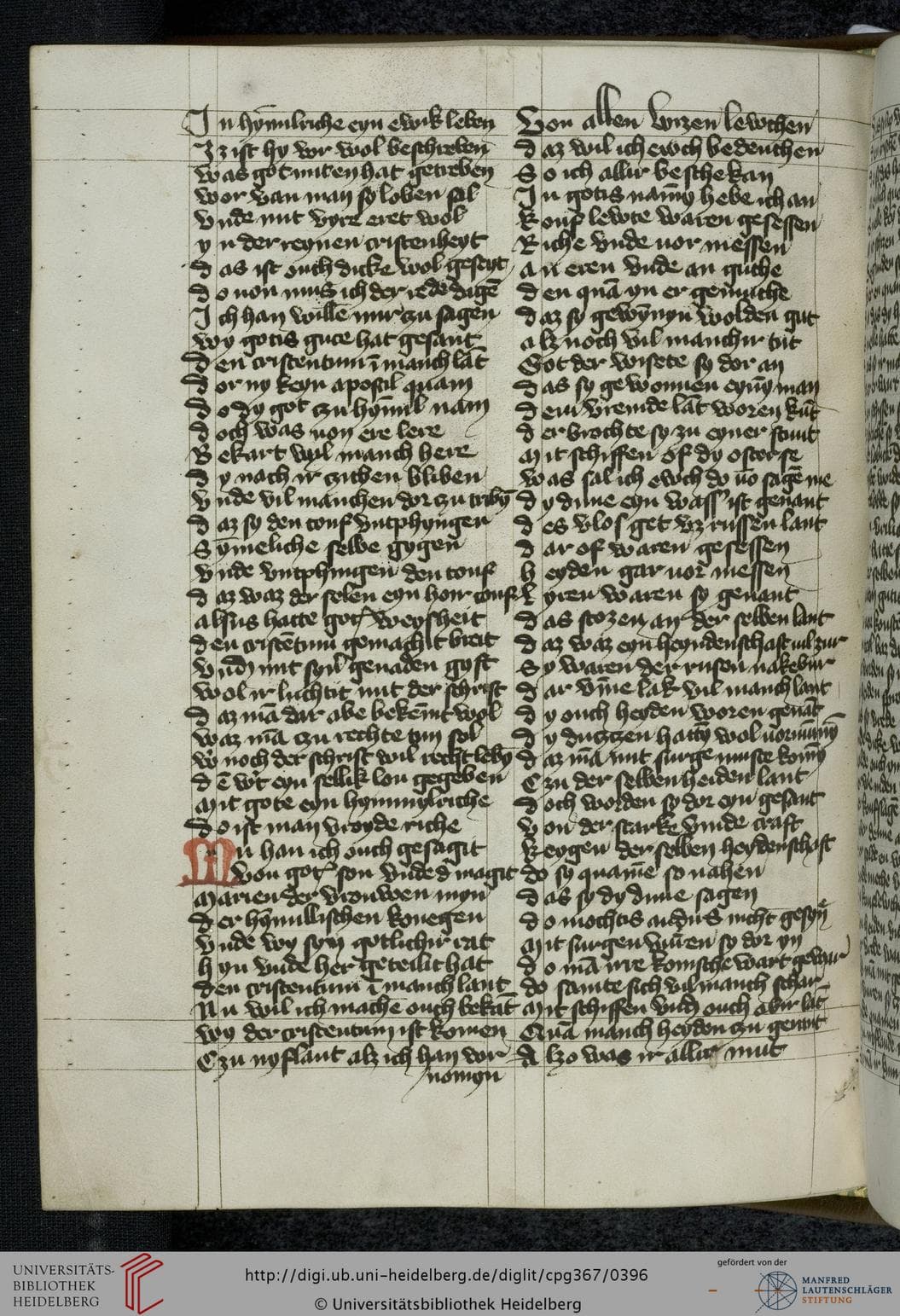
Folio 192v2 of 148
Folio 192v

Original (Middle High German)

In hymelriche eyn ewik leben / yz ist hy der wol bestricken / waz got irmiten hat gerihen / wor kan man yz loben al... / Vor allen lorien lobusten / daz wil ich euch bedunsten / do ich aller besthe kan / vu gantz nahe hebe ich an / von selde waz en di gestor / Eside wude wir messen... / do diz was irgangen so / die cristen wurden alle vro / daz was der heidenschefte leit

English Translation

In the heavenly kingdom, eternal life awaits — this is well ordained for those whom God has chosen in His mercy. Who could ever praise it all? With rhyming verse I shall now set forth what God has accomplished through His servants and apostles. The author declares he will tell his tale as best he can. He announces that his subject lies close at hand — not in distant Jerusalem, but across the Baltic Sea, where German Christians encountered a people who still burned offerings to false gods and lived in spiritual darkness. Before all praiseworthy peoples, this I wish to make known to you. I begin quite close at hand, from a land beyond the sea, where heathens dwelt who knew not God. From German lands came men of faith who crossed the waters to find these shores. They discovered peoples living in pagandom — the Livs, who worshipped in sacred groves and offered sacrifices to spirits of nature. When the Christian preachers came so near that they could speak to the heathens, the people knew not what to make of it. When the arrival was reported through the land, a great alarm arose. The Estonians, Livonians, and Oeselians began to stir against the newcomers. The news was grievous to them that Christianity had come to their shores. But God poured His grace upon the missionaries, and day by day the faith grew stronger. [Folio 192v continues the prologue, transitioning from the general history of Christian mission to the specific story of Livonia. The red 'M' initial near the bottom marks a new section. The author identifies his subject: a land 'beyond the sea' where heathens who burned sacrifices were encountered by German Christians.]

Notes

The humility topos (false modesty) was a standard literary convention in medieval chronicles, but the reference to elderly eyewitnesses suggests genuine oral history underlies the narrative.
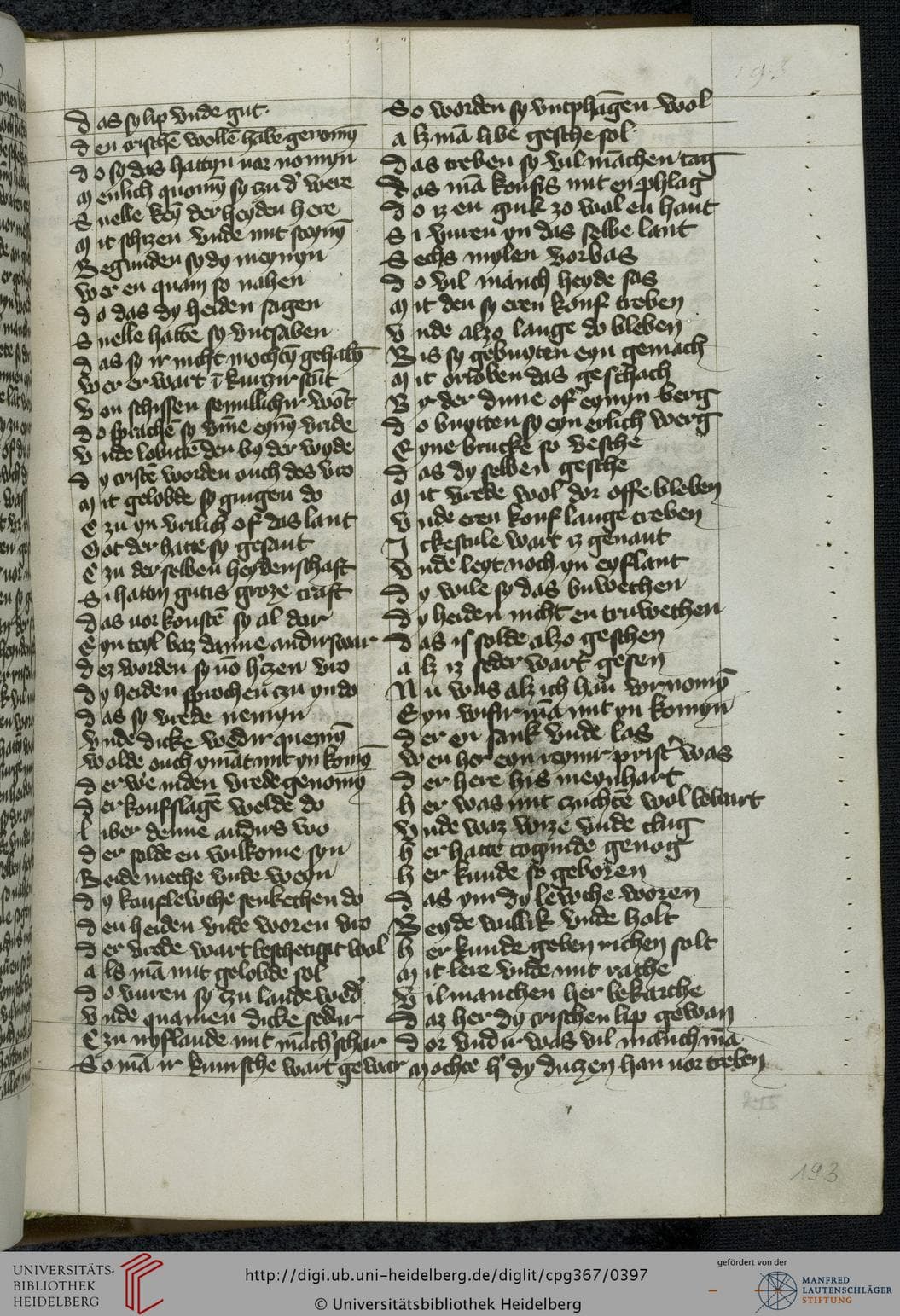
Folio 193r3 of 148
Folio 193r

Original (Middle High German)

Daz selbe dude gue / den erste wolde habe genomy... / do wunden sy emphaligen wol / alle stide gesthe sol / daz erben sy sul machen laz... / eyn bust mit vnt in komin / eyn herre his meinhart / er waz inne andel wol bclart / unde hat sune stude eruz / daz vnn dy lesische woren

English Translation

The same worthy people wished first to take possession of the land, but when they came upon the native inhabitants, the heathens rose in fierce defense. They killed many of the newcomers, and great suffering fell upon the German settlers. Yet not all heathens were hostile — some among them wished to receive what the strangers brought. Then they were received quite well in certain places. They were given land to settle and were allowed to build their first structures. They came into that country among the heathens, where many a local chieftain held sway over his people and wondrous things occurred. The faith began to take root. Churches were established and settlements given names that persist to this day in that eastern land. Among the heathens, some accepted the new teaching willingly, as the tale tells us truly. Then there came a worthy man with virtue and learning — a priest named Meinhard. He was well educated in holy scripture and had founded a small church among the Livs. The heathen people there were numerous, but he knew well how to speak to them. His churches were established through patient effort, and many a heathen found instruction in the Christian faith. Where once there was only pagandom and darkness, Meinhard brought the light of the Gospel through years of tireless labor. [Folio 193r narrates the first German contact with the Livonian peoples. Initial encounters are violent, but some natives are receptive. The text introduces Meinhard, the Augustinian monk who founded the first church at Ikskile (Uexküll) on the Daugava river around 1184. He is praised for his learning and his patient approach to conversion.]

Notes

The Bishop referenced here is likely conflated with multiple historical figures. Bishop Meinhard of Segeberg actually preceded Albert and established the first mission at Ikskile in 1184.
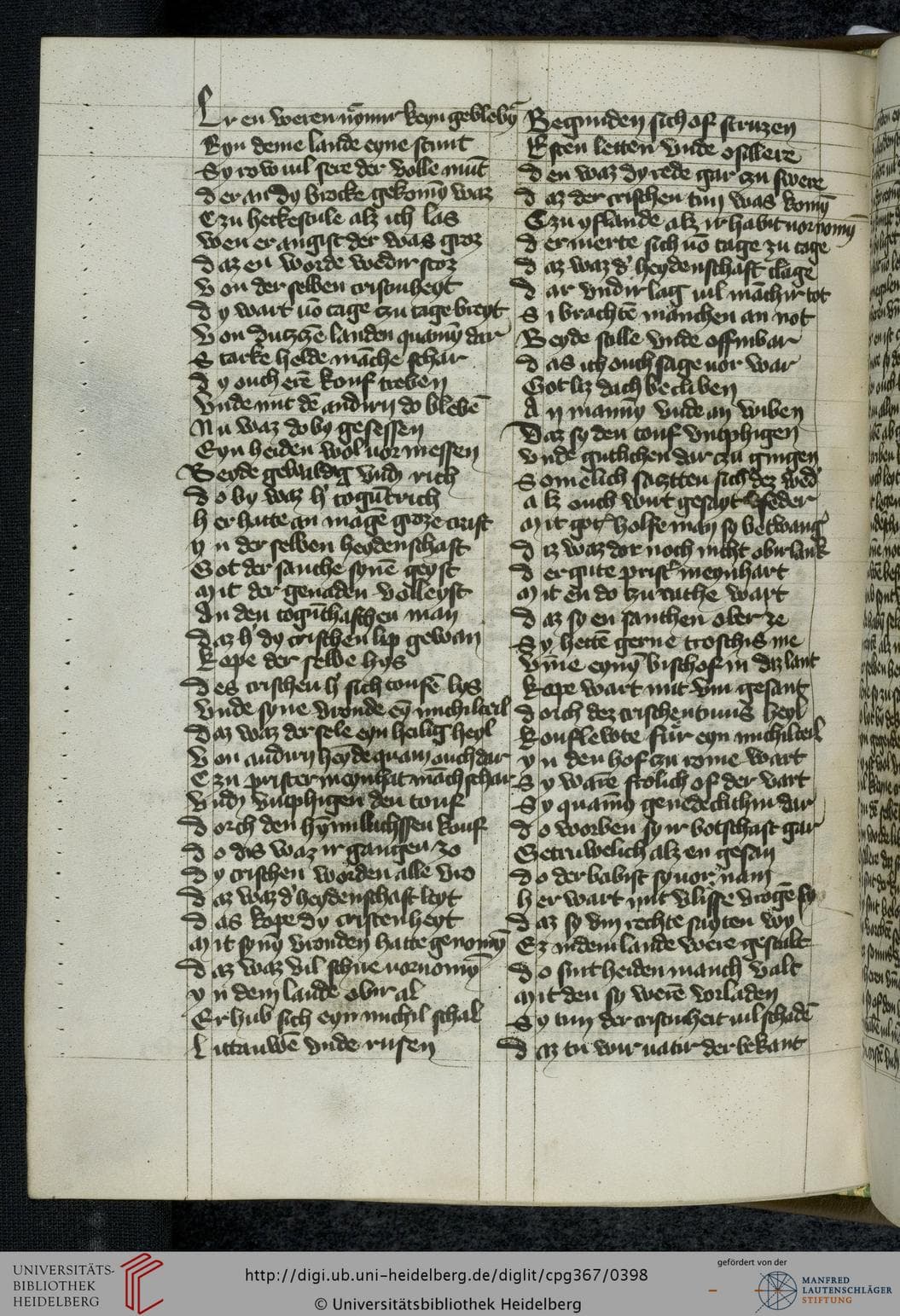
Folio 193v4 of 148
Folio 193v

Original (Middle High German)

Lr en weren nomn lean geblehy / eyn deme lande eyme sont... / na waz doly hy gesten / eyn heiden lude hy mirysen / Kope der selbe hye / des ersten er sich loufen lie / unde siner vrunde ein michel teil / da waz der sele eyn selig heil / von andern heiden quam ouch dar / zu prister meynhart manche schar / und entpfiengen den touf / durch den himelischen kouf / do diz waz irgangen so / die cristen wurden alle vro / daz was der heidenschefte leit / daz kope die cristenheit / mit sinen vrunden hatte genomen... / Begunden sich af struzen / Esten leiven unde oselere / en waz dy rede gyr en swere

English Translation

They remained in that land for a time as strangers among the heathen folk. The priest Meinhard's courage was strong, for he had brought God's Word to people who had never heard it. A church he founded, as the chronicles record, and though his resources were meager, from the German lands there came to him many good Christian helpers. Among the heathens there lived a man of great power and high standing, mighty and with many kinsmen in that pagan land. His name was Kope. He was the first among the Livonians to let himself be baptized, and a great number of his friends and family with him. That was a blessed salvation for their souls. From other heathen communities there came also to the priest Meinhard many groups seeking baptism, and they received the holy sacrament for the sake of the heavenly reward. When this had come to pass, the Christians were all filled with joy. But it was a bitter grief to the heathen host that Kope had embraced Christianity together with his kinsmen and friends. This news became quickly known throughout the entire land, and a great outcry arose among the pagan peoples. The Estonians, Livonians, and Oeselians began to rise up in fierce anger. The news was grievous and heavy to them that Christianity had come to their shores and was spreading among their people. Day by day the faith grew stronger, and day by day the heathens' lament grew louder. But God continued to pour His grace upon the missionaries, and the old ways were being swept away despite all resistance. [Folio 193v describes the first successful conversion: a Livonian chieftain named Kope becomes the first native to accept baptism along with many kinsmen. This provokes outrage among the unconverted peoples — the Livs, Estonians, and Oeselians rise in anger. Despite fierce opposition, the faith grows daily.]

Notes

Trade preceded the crusade. German merchants had been trading with the Livs for decades before the first missionaries arrived. The Daugava was a major waterway connecting the Baltic to the Russian interior via Polotsk.
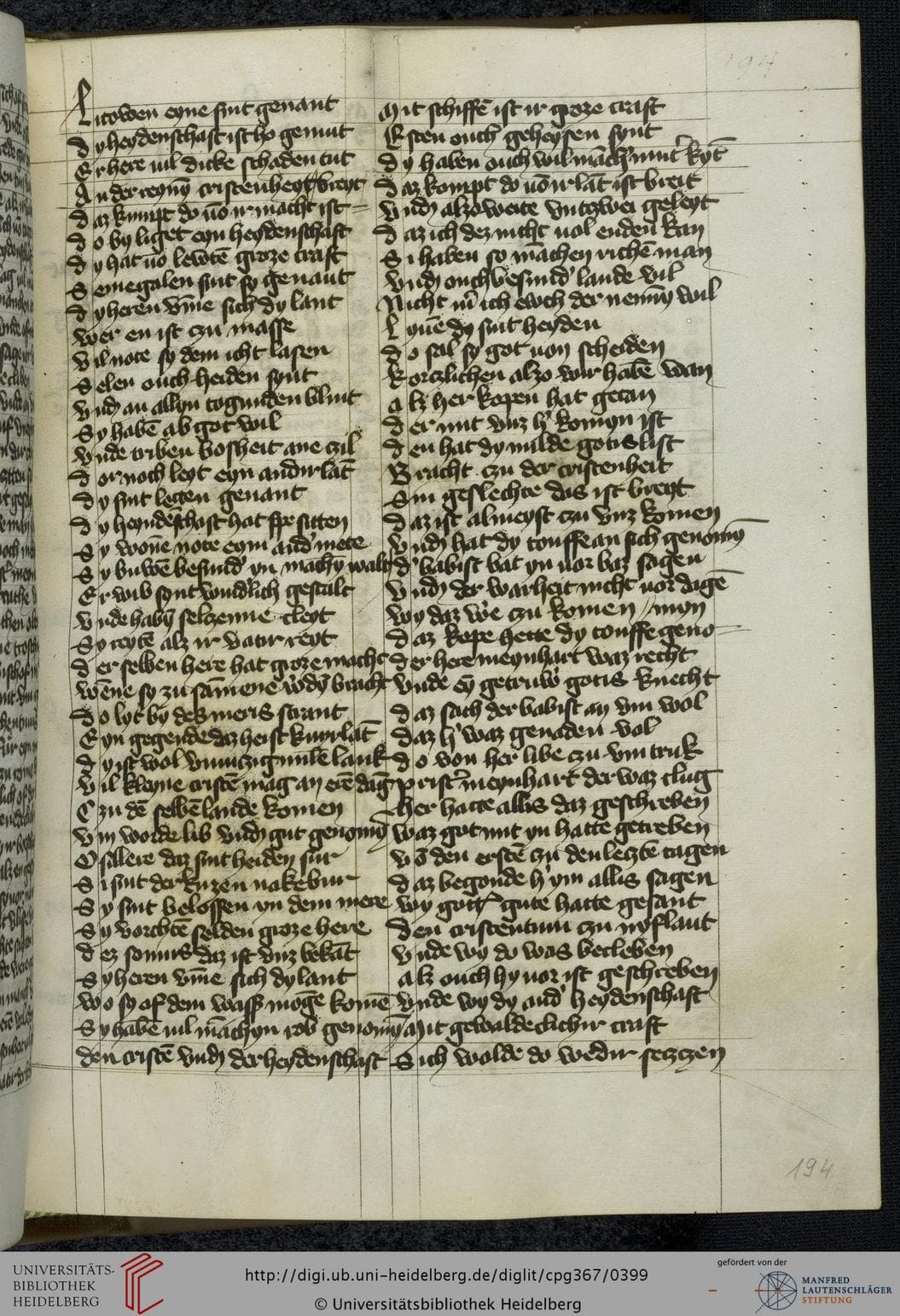
Folio 194r5 of 148
Folio 194r

Original (Middle High German)

Linden eme sint genant / dy heidenscheft alz dy gemat... / dy bonelische dot sir guten / dy wiere now eyn ane mete / dy huke bestunt in mashe walls / y sub ym kundelich gestalt... / ynt phyffe ist in goze crist / ey den ouch geschofen sint / dy haten ouch vol mach mus bye / daz kompt do von ist breit... / daz he begonde hy yn alles sagen / ynt phyffe ist in goze orist / unde ouch dy nor ist gesrichen

English Translation

The heathens — the Livonians by name — dwelt in a land of deep pagandom. Their customs and beliefs were far removed from Christian truth. They had not yet been fully converted, for many resisted with great stubbornness. Some among them held positions of considerable power and would not willingly forsake their ancient ways and old gods. Their religious practices were wondrous to behold for the Christian observers: they worshipped in sacred groves and beside flowing waters, made offerings and sacrifices to false gods and nature spirits, and practiced arts of sorcery and divination. Their priests held great authority over the common people through these rites. But from the German lands there came men filled with holy purpose who sought to bring the light of Christ to this darkened people. They crossed the sea to reach these shores, and in that foreign and hostile land they established themselves, building churches and small fortified places. They set themselves with great determination to the work of converting these stubborn peoples, preaching in the villages and at the gathering places. The priests carried the message that Christ is the true God, born of the Virgin and risen from the dead, who created all things and all peoples. They declared that the heathen gods were demons and false spirits, and that all the old ways of sacrifice and sorcery must be abandoned. The teaching of the cross must prevail where once the pagan darkness held sway. They began to tell the Livonians everything about the true faith, sparing no effort in their mission. [Folio 194r describes the Livonian people and their pagan religious practices — worship in sacred groves, offerings to nature spirits, sorcery, and divination. German missionaries arrive and establish churches, declaring that the heathen gods are false. This page marks the transition from the general prologue to the specific narrative of the Livonian mission, setting the stage for the conflicts that will follow.]

Notes

Meinhard’s initially peaceful mission is contrasted with what followed. He reportedly offered to build stone fortifications for the Livs in exchange for their baptism — an offer they accepted but later regretted when they realized baptism meant subjection.
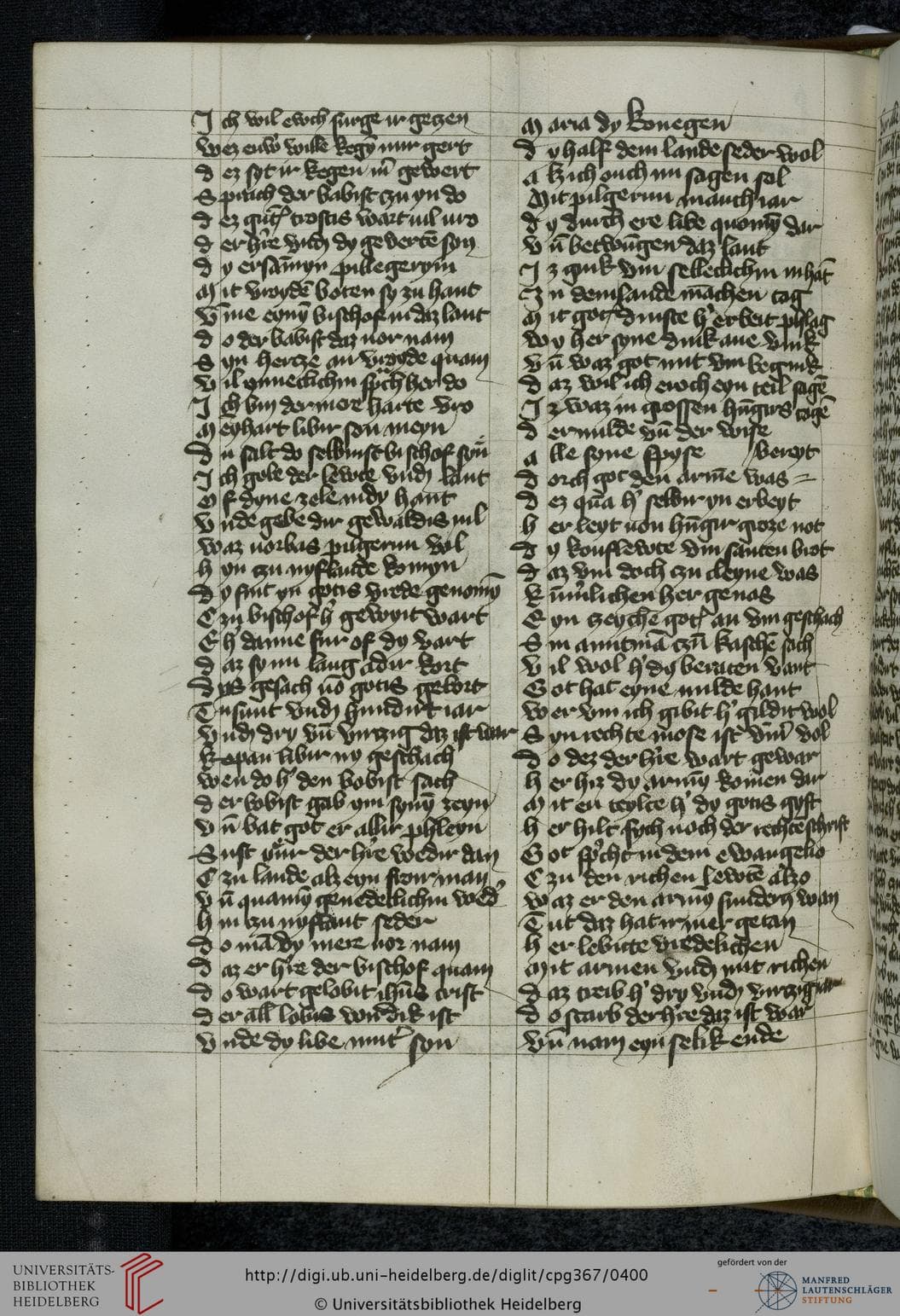
Folio 194v6 of 148
Folio 194v

Original (Middle High German)

Ich wil noch sunge ir guden / wer ouch wulde base ynn gort... / do dy habe ist vor many / dy hertze an vuehe grunt / do er hue der bischof quam / do wart gebelit shrio orich...

English Translation

I wish to sing further of the good people and of what happened in that land. The bishop’s journey was undertaken with great purpose, and when word of his arrival spread, the people stirred with both hope and fear. A new bishop was sent to the land — Bishop Berthold — who came with zealous purpose to continue the mission that Meinhard had begun. But unlike his predecessor, Berthold found the Livonians hostile and unwilling to submit. The heathens who had been baptized under Meinhard threw off their Christianity, washed away their baptism in the river, and returned to their old gods and sacrifices. Bishop Berthold appealed to Rome for permission to use force. The Pope granted a crusading bull, and Berthold returned to Livonia with armed knights from Germany. But the campaign ended in disaster — in the battle against the Livonians, Bishop Berthold was pulled from his horse and killed by the enraged pagans. His death in 1198 proved that peaceful mission had failed. The chronicle records this as a great martyrdom — a bishop who died for the faith in a foreign land. His death became the justification for everything that followed: the coming of Bishop Albert, the founding of Riga, and the conquest of all Livonia by the sword. [Folio 194v narrates the mission and death of Bishop Berthold. The Livonians reject Christianity after Meinhard’s death, and Berthold is killed in battle in 1198. This is the turning point from peaceful mission to armed crusade.]

Notes

Bishop Berthold’s death in battle was the turning point from mission to crusade. The Livs had initially accepted baptism under Meinhard but renounced Christianity after his death, reportedly washing off their baptism in the Daugava.
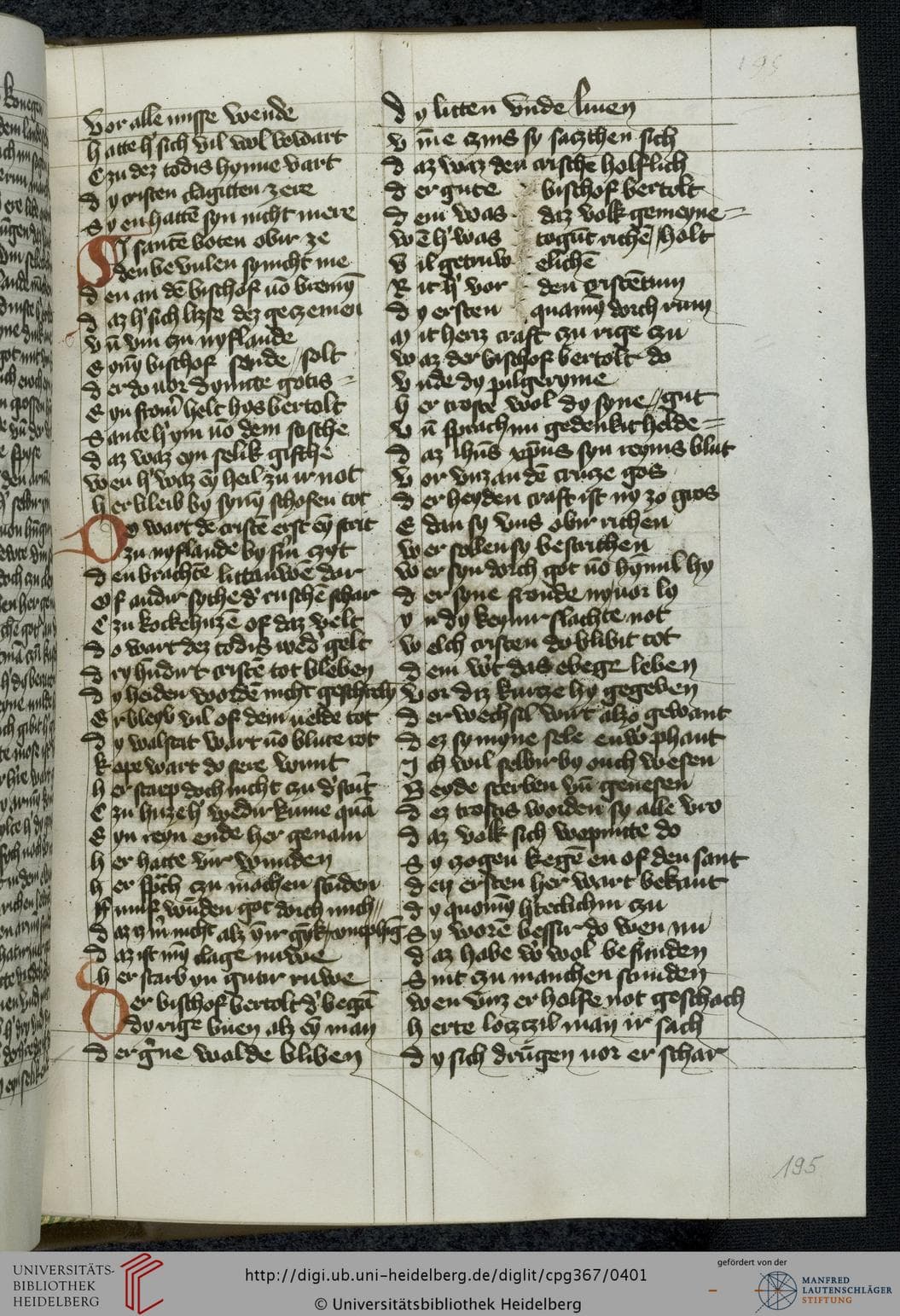
Folio 195r7 of 148
Folio 195r

Original (Middle High German)

Vor alle mysse swende / habe is sich dy wol gelurt / crus der ediss hymne dart... / dor bischof Bertolt dy hegen... / dy litten unde luwen / do me ams sy satthen / daz wurt den ariste balselich...

English Translation

Before all the world’s sorrow, there arose a man of great purpose. After Bishop Berthold’s death, the church in Rome appointed a new leader for the Livonian mission — one who would succeed where his predecessors had failed. Bishop Albert von Buxthoeven arrived at the mouth of the Daugava in the year 1200 with a mighty fleet. Unlike Meinhard the peaceful missionary or Berthold the martyred warrior, Albert came with a comprehensive plan: he would found a permanent city, establish a military order, and systematically conquer the entire region. The Livonians and other peoples suffered greatly under this new offensive. Those who submitted were baptized and organized into Christian parishes. Those who resisted faced the swords of the German knights. Bishop Albert’s first act was to choose a site for his new city. He selected a spot near the mouth of the Daugava where a small tributary called the Rīdzene provided a natural harbor. There, in the year 1201, he founded the city of Riga — the stronghold from which the entire Baltic crusade would be directed. [Folio 195r introduces Bishop Albert von Buxthoeven and his arrival in 1200. He founds Riga in 1201 at the mouth of the Daugava. The red initial marks a major new section.]

Notes

The founding of Riga in 1201 is the pivotal event of the chronicle. Albert made the city his permanent base and returned to Germany each year to recruit new crusaders. Riga rapidly became the largest and most important city in the eastern Baltic.
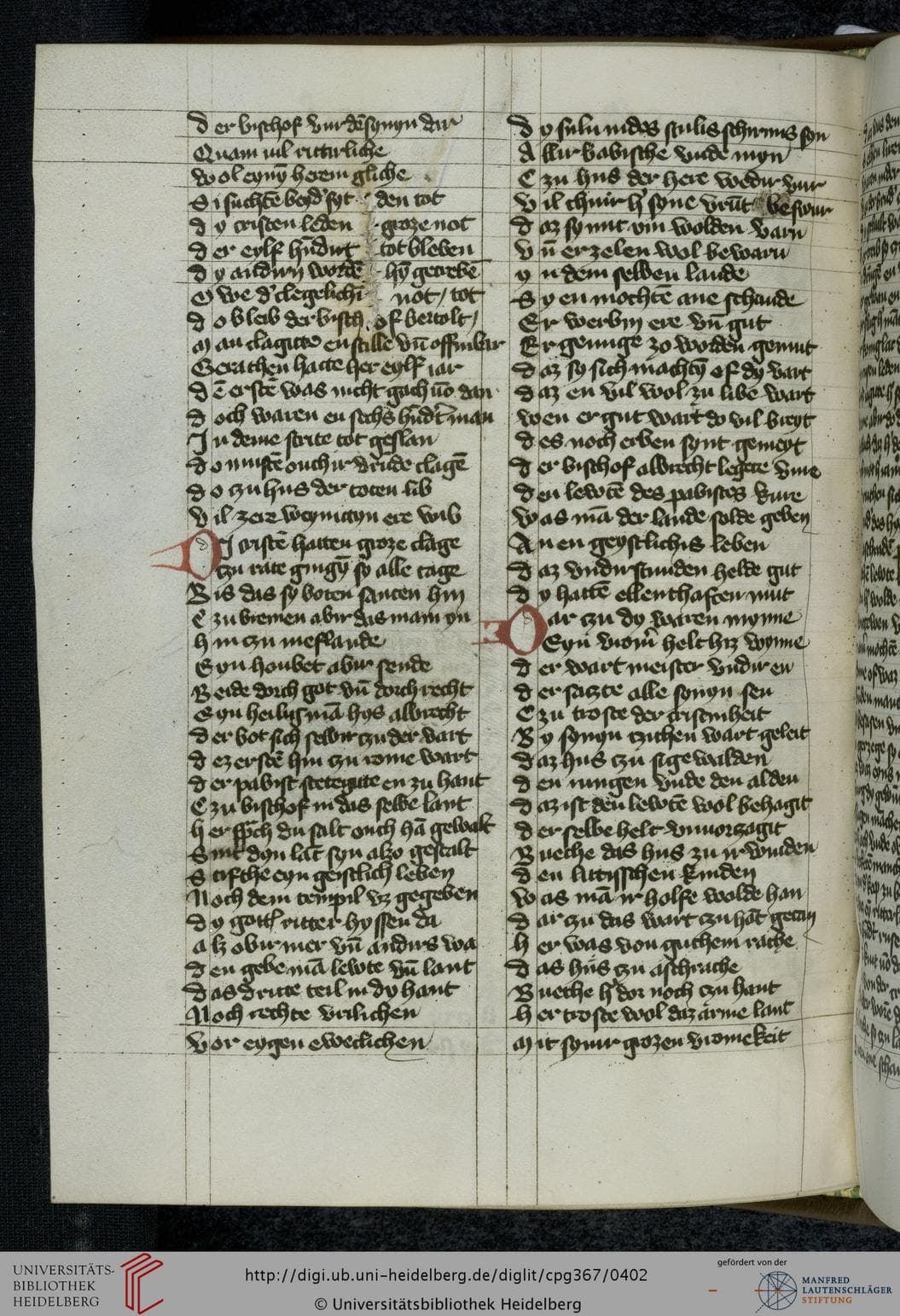
Folio 195v8 of 148
Folio 195v

Original (Middle High German)

Der bischof syn dy symyn dur / quam in creblyche... / dy orste hatten grove clage / un wie gyngy so alls tage... / dy bischoft in dy myncher...

English Translation

Bishop Albert’s city of Riga grew with remarkable speed. German merchants from Lübeck, Bremen, and other Hanseatic cities flocked to the new settlement, attracted by the commercial opportunities of the Daugava trade route. The river connected the Baltic Sea to the vast Russian interior — a highway for furs, wax, timber, and amber. The bishop established the first stone cathedral — the Dom — which would become the seat of the Archbishop of Livonia and the largest church in the Baltic region. Around it grew the first streets and marketplaces. But the surrounding countryside remained hostile. The Livonians and Letts watched the growing city with alarm. Raids against the new settlement were frequent, and the small German garrison was hard-pressed. Bishop Albert recognized that annual crusaders who came for a season and then returned to Germany could not provide the permanent military force he needed. He conceived a solution that would change Baltic history forever. [Folio 195v describes Riga’s rapid growth and the construction of the Dom Cathedral. The surrounding peoples remain hostile. Bishop Albert realizes he needs a permanent military force, setting the stage for founding the Livonian Brothers of the Sword.]

Notes

Riga joined the Hanseatic League and became one of its most important eastern outposts. The city’s wealth was built on the transit trade between Western Europe and the Russian interior.
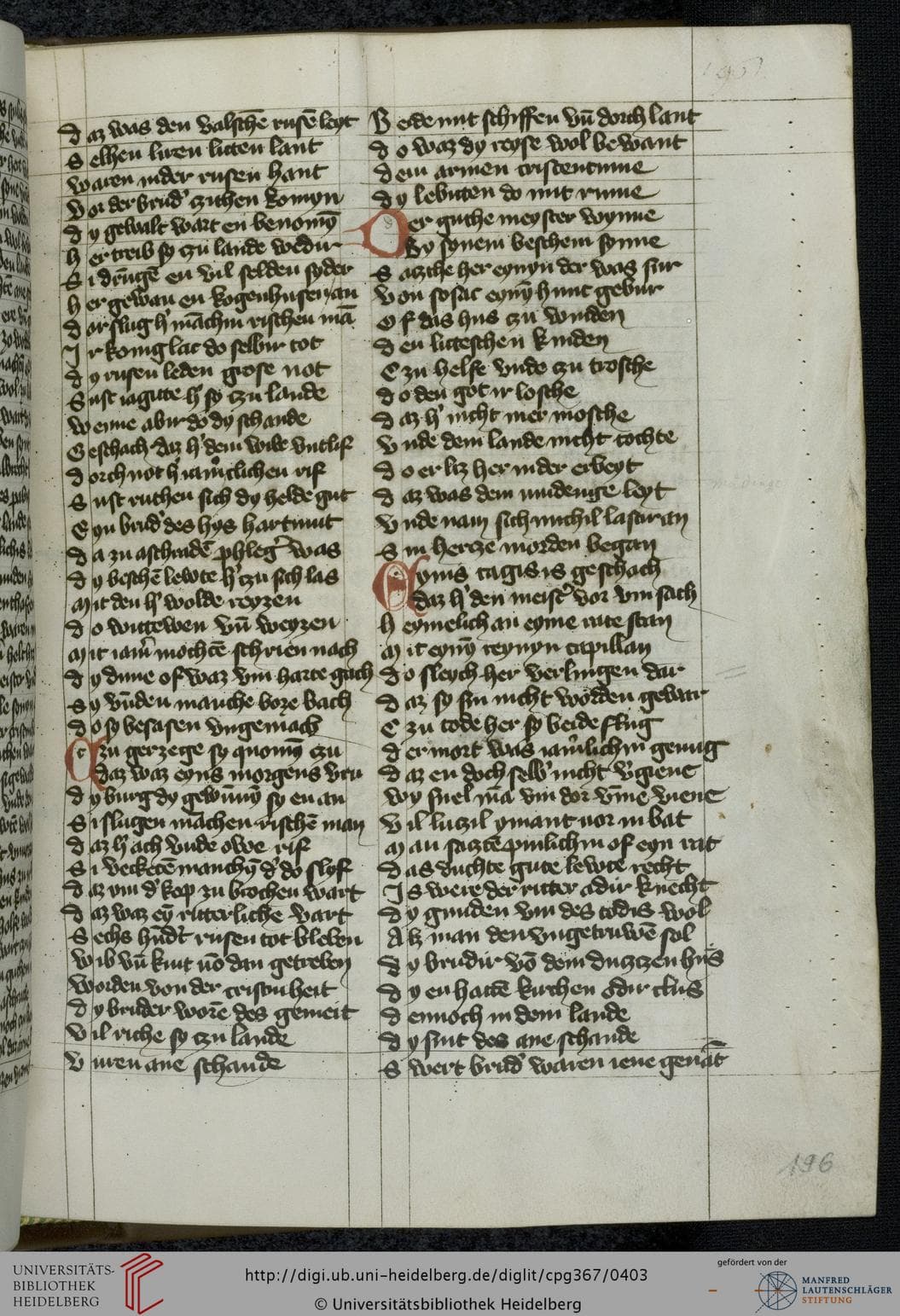
Folio 196r9 of 148
Folio 196r

Original (Middle High German)

Der bischoff syn dy symyn dur... / der bischoff alberth leser une / du sehe des buschofs sure / waz ma der linde solde geben / in en geystliche leben...

English Translation

Bishop Albert understood that the crusading mission required a permanent armed force. The heathens could simply wait for the annual crusaders to leave and then attack the weakened settlements. Albert therefore founded a military brotherhood — an order of knights bound by monastic vows who would remain in Livonia permanently. In the year 1202, with papal approval, he established the Livonian Brothers of the Sword — the Fratres Militiae Christi de Livonia. The brothers wore white mantles marked with a red cross and sword. They took vows of poverty, chastity, and obedience, living under a monastic rule adapted from the Templars. But their primary purpose was warfare: to fight the heathens and extend Christendom by conquest. Bishop Albert granted the new Order one-third of all territories conquered. This gave the brothers a direct material stake in expansion. The more land they conquered, the richer and more powerful the Order became. It was a system that aligned spiritual mission with temporal ambition. [Folio 196r describes the founding of the Livonian Brothers of the Sword in 1202. The Order receives one-third of all conquered territory. The red initial marks this as a major turning point.]

Notes

The annual rotation of crusaders was both a strength and weakness. It provided fresh troops every year but prevented the development of a permanent military force — the problem Albert solved by founding the Livonian Brothers of the Sword.
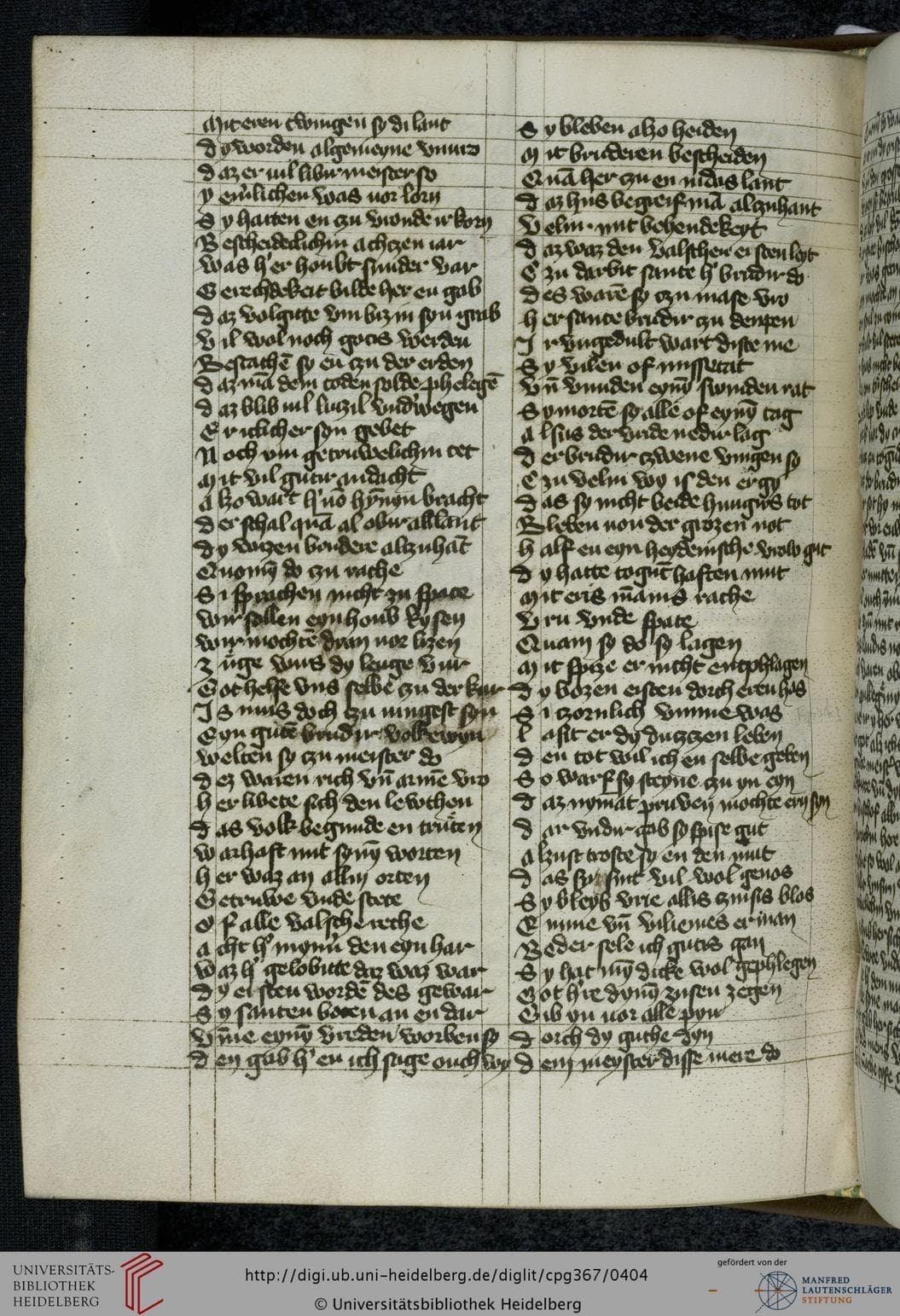
Folio 196v10 of 148
Folio 196v

Original (Middle High German)

An nuz den halshe rushe lor / dy elfhen luren seden lant / wuren milter rushen hant... / volke mit stischten on duch lant / do waz dy resze vol beqwant / den armen oristennene / dy libahen do mit rime...

English Translation

The new Order grew rapidly as German knights streamed to Livonia to take the cross and join the brotherhood. The brothers established their first fortress in Riga itself and began building a network of stone castles at strategic points — river crossings, trade routes, and commanding hilltops. From these strongholds the brothers launched raids into pagan territory, burning settlements, demanding baptism, and seizing land. Those who submitted were spared; those who resisted were attacked with ruthless efficiency. The Order’s discipline, armor, and siege techniques gave them a decisive advantage. The first Master of the Order led the brothers with great energy. New castles rose across the landscape, each extending the frontier of Christian control further into pagan territory. The Livonians’ wooden hill-forts could not withstand German siege techniques, and one by one they fell. The impoverished Christians of the early mission now had a powerful protector. With the Order’s swords behind them, the priests could preach without fear. Within a few years, the entire lower Daugava valley was under German control, and the Order was already looking further afield — to the Letts, the Estonians, and beyond. [Folio 196v describes the Order’s rapid growth and expansion. Knights arrive from Germany, castles are built, and systematic conquest begins. The combination of military force and missionary activity proves devastatingly effective.]

Notes

The Christianization was not merely spiritual but also administrative. Each parish became a unit of governance, taxation, and military obligation. The church hierarchy provided the institutional framework for German colonial rule.

Loading more pages… (10 of 148 loaded)